Yes — typical rollouts start with inventory and finance, then production and agents.
Architecture
ERP system architecture
Modular core, agent layer, and connector fabric — designed for change.
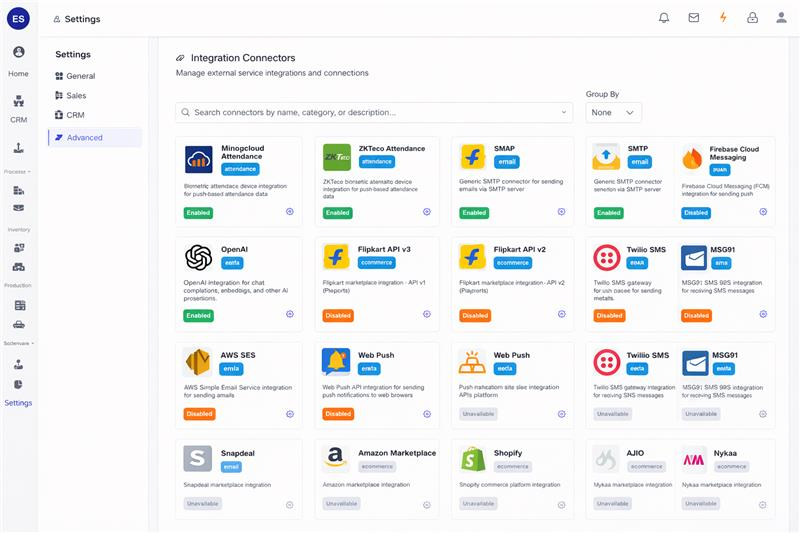
Modern ERP architecture separates a governed transactional core from an agent orchestration layer and integration connectors — so AI automation and new channels plug in without destabilising finance and inventory masters.
Architecture · live
Live pathCore masters → agents → connectors — change at the edge.
Clean core, composable edge
Finance and inventory masters stay rigid for audit; agents and connectors operate at the edge where change is fastest — marketplace rules, AI models, attendance devices.
Phased migration without big-bang risk
Start with inventory and finance on Infuro while Tally syncs via API; add production, agents, and marketplace connectors as each workstream is ready.
AI AGENTS
Autonomous ERP Agents
AI agents continuously monitor workflows, automate routine operations, and assist teams across finance, inventory, procurement, compliance, and workforce management.
Finance Agent
The Finance Agent automates forecasting, reconciliation, approvals, anomaly detection, and multi-entity reporting across enterprise ERP environments.
✓
Automated invoice processing✓
Cash flow forecasting✓
Multi-entity consolidation✓
Audit-ready reportingCapabilities
Built for production workloads
Core
Modular domains
Finance, inventory, production as bounded modules.
Agents
Orchestration layer
Autonomous agents with human-in-the-loop gates.
Integration
Connector fabric
Marketplaces, Tally, biometric, LLM APIs.
Data
Single source
One master for items, parties, and GL.
FAQ
ERP system architecture — common questions
Direct answers on architecture, deployment, and how Infuro fits your stack.
Talk to our teamTalk to an ERP architect
See how agentic workflows, connectors, and GST-ready modules fit your stack.