Similar goals, but embedded in ERP domain events — PO matched, batch quarantined — not generic cloud plumbing.
Architecture
Event orchestration engine
Coordinate agents, workflows, and connectors from a single event bus.
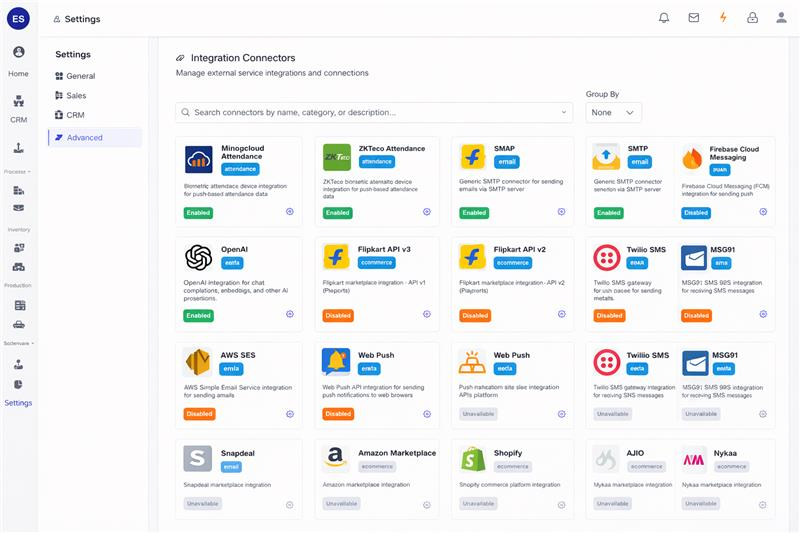
An event orchestration engine routes business events to the right handler — workflow step, integration connector, or AI agent — with retries, dead-letter queues, and observability for enterprise reliability.
Orchestration · live
Live pathIngest → route → retry → multi-agent → trace.
The 2026 integration pattern
Rather than point-to-point scripts, orchestration lets you add a fifth agent or connector without rewiring every integration — critical as agentic ERP adoption accelerates.
Trace every event to an outcome
Dead-letter queues, retries, and trace logs show whether a marketplace stock update, agent action, or workflow step succeeded — essential when finance and ops share one pipeline.
AI AGENTS
Autonomous ERP Agents
AI agents continuously monitor workflows, automate routine operations, and assist teams across finance, inventory, procurement, compliance, and workforce management.
Finance Agent
The Finance Agent automates forecasting, reconciliation, approvals, anomaly detection, and multi-entity reporting across enterprise ERP environments.
✓
Automated invoice processing✓
Cash flow forecasting✓
Multi-entity consolidation✓
Audit-ready reportingCapabilities
Built for production workloads
Routing
Rule-based
Route events by type, entity, and severity.
Agents
Multi-agent
Sales, purchase, and finance agents collaborate on one event.
Reliability
Retries
Failed connector calls retry with backoff.
Observability
Trace log
See full chain from event to action.
FAQ
Event orchestration engine — common questions
Direct answers on architecture, deployment, and how Infuro fits your stack.
Talk to our teamTalk to an ERP architect
See how agentic workflows, connectors, and GST-ready modules fit your stack.