ERP that runs multiple legal entities on one platform with isolated books, shared or federated masters, inter-company transactions, and consolidated reporting.
Global operations
Multi-organization ERP
One control tower for legal entities, currencies, deliveries, commissions, and export visibility.
Multi-organization ERP runs separate books for each legal entity while sharing masters, workflows, and consolidated reporting — so groups scale without spreadsheet sprawl or siloed logistics tools. Buyers often call this multi-entity ERP: the same need for subsidiaries, inter-company, and group close on one platform.
Multi-org path · live
Live pathEntity → books → FX → consolidate — one control tower.
What multi-organization ERP means in practice
Each legal entity keeps its own chart of accounts, tax rules, and user access. Items and parties can be shared or federated so sales and warehouse teams are not re-keying masters. Inter-company stock transfers and invoices post due-to/due-from automatically. Month-end consolidation rolls entities into the holding company view without a separate spreadsheet pack. That is the operating model Infuro delivers for exporters, distributors, and group companies.
Multi-entity ERP: the buyer term that maps to this page
Search and RFPs often say multi-entity accounting or multi-entity ERP. Functionally that means multiple companies, shared or mapped COA, intercompany automation, multi-currency, and consolidated financials. Infuro’s multi-organization layer is built for that brief — not just cost centres inside one company. If you outgrew QuickBooks-style multi-company or a single-entity India GST stack, this is the control tower you need before adding more warehouses or countries.
Multi-company ERP is the same operating problem
Buyers also search multi-company ERP or multi-company accounting when they need more than one legal entity on shared masters. The requirement is identical: separate books, intercompany due-to/due-from, multi-currency where trade crosses borders, and a group close that finance can audit. Infuro treats multi-organization, multi-entity, and multi-company as the same capability set — one control tower, clear entity boundaries.
Why groups outgrow single-company ERP
When you add subsidiaries, export markets, and field sales territories, spreadsheets and bolt-on TMS tools break. Inventory lives in one system, FX in Excel, commissions in another workbook, and container ETAs in a carrier portal. Infuro keeps entities, FX, dispatch routes, and commissions on one data model — finance posts from the same invoices operations already raised. Typical inflection points: three or more warehouses, a second GSTIN or foreign entity, or export volume that needs POD and ocean visibility together.
Multi-currency and FX on the same books
Import suppliers invoice in USD while you sell in INR and report to a Singapore or Dubai parent in SGD or AED. Entity books stay accurate; consolidation uses configured rates with realised and unrealised FX posted to the ledger. India entities keep GST e-invoicing; foreign entities run local VAT or sales-tax rules on the same platform. See the dedicated multi-currency page for rate tables, revaluation, and elimination detail.
Delivery routes and proof of delivery inside ERP
Domestic last-mile should not require a separate TMS for most distributors. Confirmed sales orders feed GPS route optimization; drivers capture POD on mobile; delivered quantities update invoices and stock. Multi-warehouse allocation picks the nearest site with available stock before promising ETAs. Route optimization is part of the sales-to-cash chain, not an orphan logistics app.
Ocean and air visibility with ShipsGo
Export and import desks need container and air waybill ETAs next to domestic dispatch — not in a third browser tab. Infuro’s ShipsGo connector brings ocean and air cargo tracking into the same ops story as warehouse routes and finance. Planners know when inbound stock lands and when field teams can promise customer dates. Carrier coverage spans major shipping lines and airlines via ShipsGo’s visibility platform.
Commissions from posted invoices, not CRM stages
Territory rules, split deals, and tiered rates calculate when invoices post — so payouts match recognised revenue. Overlapping territories, house accounts, and multi-currency export deals stop living in disputed spreadsheets. Group leadership can see payout exposure across entities while each company keeps its own scheme. Audit exports show invoice, rule, and calculation breakdown for payroll.
Multi-tenant vs multi-organization
Multi-tenant ERP is platform architecture: isolated data for partners, franchises, and white-label deployments on shared infrastructure. Multi-organization ERP is how one customer runs many legal entities day to day — books, FX, intercompany, and consolidation. Groups often need both: multi-tenant if you resell or white-label; multi-organization for operating subsidiaries. Read the comparison post and the multi-tenant page if you are still choosing language for an RFP.
Who multi-organization ERP is for
Exporters and importers with India plus Gulf, ASEAN, or EU entities. Multi-warehouse traders and distributors with field fleets. Franchise and dealer networks that need territory commissions and shared item masters. Holding companies that want audit-ready consolidation without ripping out GST-ready Indian operations. Typical go-live starts with inventory and finance in 4–8 weeks, then routes, ShipsGo, and commission rules.
AI Agents
Autonomous ERP Agents
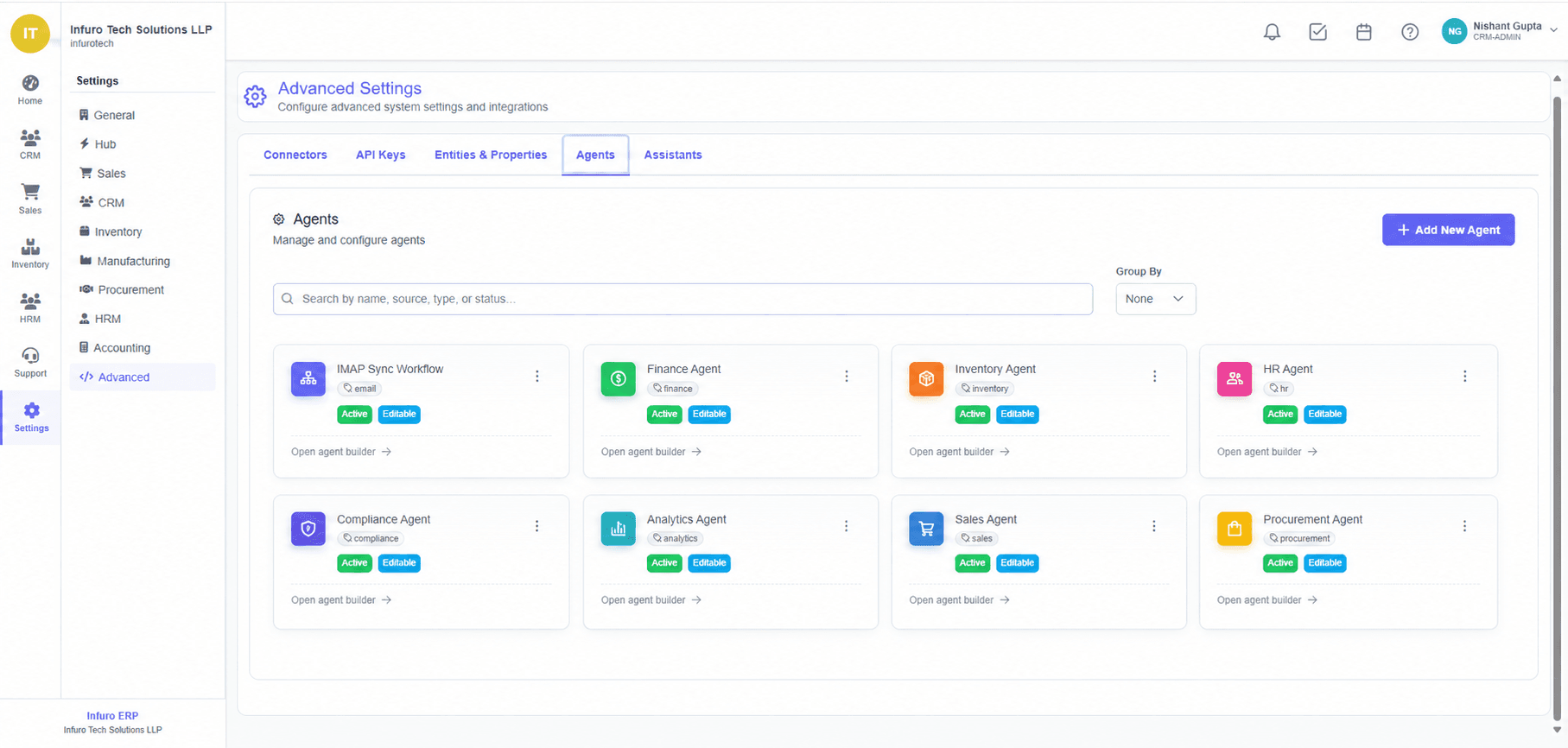
AI agents continuously monitor workflows, automate routine operations, and assist teams across finance, inventory, procurement, compliance, and workforce management.
Finance Agent
The Finance Agent automates forecasting, reconciliation, approvals, anomaly detection, and multi-entity reporting across enterprise ERP environments.
- ✓Automated invoice processing
- ✓Cash flow forecasting
- ✓Multi-entity consolidation
- ✓Audit-ready reporting
Capabilities
Built for production workloads
Entities
Multi-org
Separate COA and users per legal entity with group consolidation.
Currency
Multi-FX
Invoice, pay, and report in INR, USD, EUR, AED, and more.
Delivery
Route + POD
GPS route optimization and proof of delivery inside sales.
Visibility
ShipsGo
Ocean and air cargo tracking via ShipsGo connector.
FAQ
Multi-organization ERP — common questions
Direct answers on architecture, deployment, and how Infuro fits your stack.
Talk to our teamYes for most buyers — multi-entity is the common market term for separate companies, intercompany, and group consolidation. Infuro uses multi-organization for the same capability set.
No for practical RFPs — multi-company, multi-entity, and multi-organization all describe separate legal entities with shared or mapped masters and group reporting on one platform.
Multi-tenant is platform architecture for partners and isolated deployments. Multi-organization is how operating companies, subsidiaries, and books are managed day to day for one customer group.
Yes — raise invoices, record payments, and produce P&L in entity currency with group reporting in your chosen consolidation currency and automatic FX postings.
Yes — GPS route planning, mobile POD, and multi-warehouse dispatch live in the sales-to-cash flow without a mandatory standalone TMS for most distributors.
Yes — the ShipsGo connector brings ocean container and air cargo tracking into the same ops view as domestic dispatch and POD.
Define territory and product rules per entity; commissions calculate from posted invoices with optional splits and consolidated payout visibility for group leadership.
Yes — India entities keep GST e-invoicing and e-way workflows; foreign entities run local tax rules on the same multi-organization platform.
Most groups start inventory and finance in 4–8 weeks, then enable route optimization, ShipsGo visibility, and commission rules as each workstream is ready.
Exporters, multi-warehouse traders, franchise and distributor networks, and holding companies expanding across India and global trade hubs.
Talk to an ERP architect
See how agentic workflows, connectors, and GST-ready modules fit your stack.