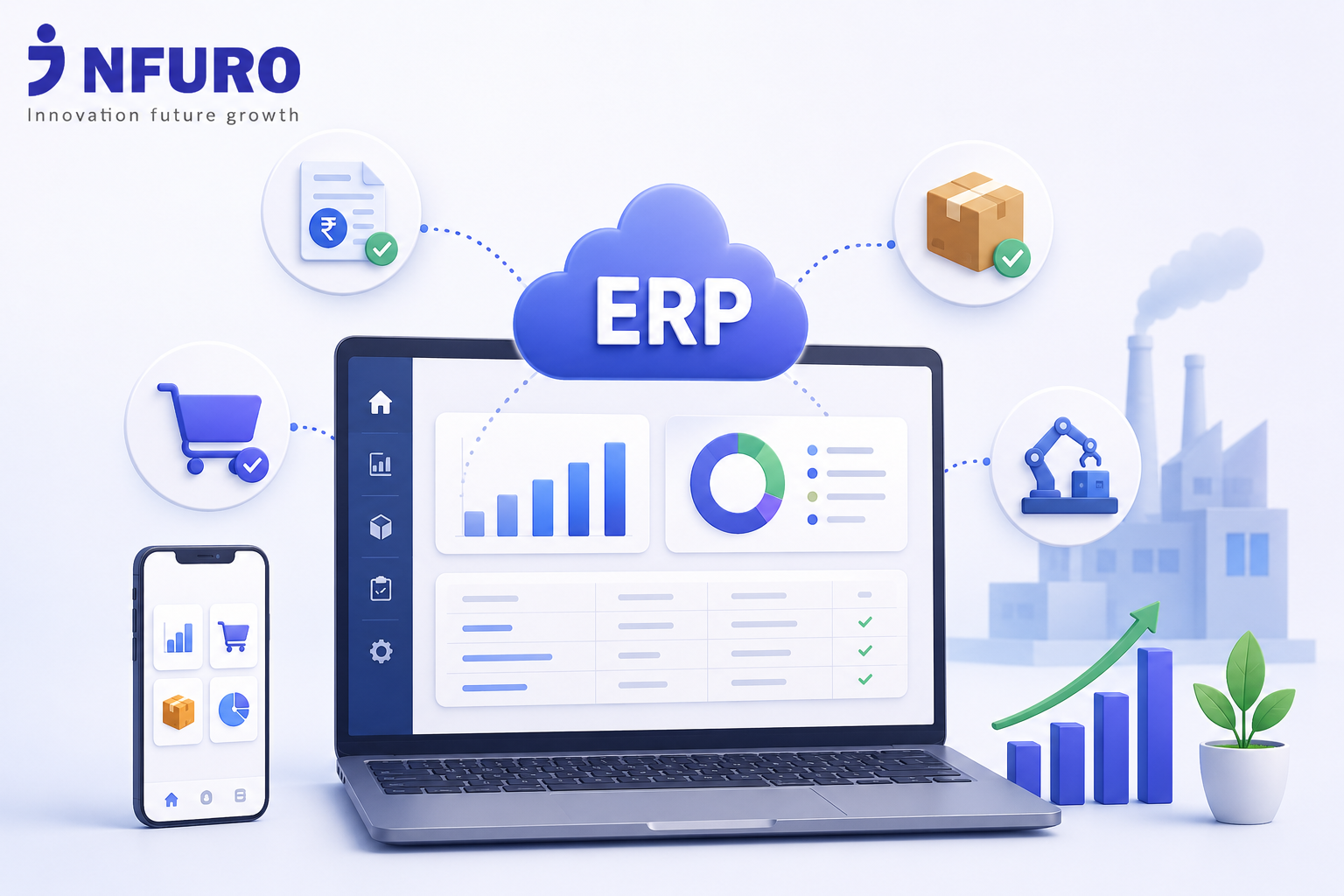
ERP trends in 2026 are not about buying more dashboards. Indian manufacturers are moving to cloud-native systems that run GST e-invoicing, inventory, and production in one ledger, with AI agents that draft purchase orders and flag exceptions. The companies pulling ahead this year are replacing Tally-plus-Excel workarounds with one live system of record.
What Is an ERP Trend in 2026?
An ERP trend is a capability that has moved from optional add-on to expected operating standard — in 2026 that means cloud delivery, GST-native invoicing, real-time inventory, and AI that acts on data instead of only reporting it.
Five years ago, “ERP” for many Indian plants still meant a finance package, a separate inventory spreadsheet, and WhatsApp for purchase approvals. That stack still runs thousands of factories. It also explains why stock figures disagree with the books, why IRN generation is a last-minute scramble, and why production delays surface only in the next morning’s MIS.
The current cycle is different from the old “digital transformation” pitch. Buyers are not asking for a 18-month programme. They are asking whether the system can raise a GST-compliant invoice, show warehouse stock on a phone, and stop a bad GRN before it hits accounts. Those are the ERP trends 2026 that actually get signed.
If you are still comparing accounting software with operations software, start with when a business outgrows Tally. The rest of this guide assumes you already feel that gap.
Why ERP Trends Matter for Indian SMEs This Year
Trends matter when they change cash, compliance, or throughput. In 2026 they do all three at once.
GST e-invoicing is no longer a side portal. For businesses above the current turnover threshold, invoices must hit the Invoice Registration Portal in real time. A system that cannot post IRN and QR codes as part of the sales flow creates penalty risk and delayed collections. See how GST e-invoicing works inside ERP.
Working capital is the second pressure. Carrying 15–25% extra inventory because nobody trusts the stock figure is expensive at 12–18% cost of funds. A live inventory module that updates from GRN, production issue, and dispatch is the trend that pays for itself fastest.
The third pressure is labour. Plant managers, store keepers, and accountants are already doing the work — they are doing it in three tools. Unifying purchase indent → PO → GRN → invoice matching is not a “nice UI.” It is how you stop 80–120 hours a month of reconciliation.
Cloud is the delivery model that makes the other trends affordable. You do not buy servers, you do not wait for a GST Council rule change to become a custom patch, and sales or quality staff can open the same record from the factory floor. That is why cloud ERP for Indian manufacturers is now the default recommendation, not a future option.
| Capability | Legacy stack (Tally + Excel + WhatsApp) | 2026 cloud ERP |
|---|---|---|
| Deployment | Months of hardware, licences, and IT staff | Weeks; browser and mobile, vendor-hosted |
| GST e-invoicing | Manual IRP upload, delayed IRN | API to IRP; IRN and QR on the invoice PDF |
| Inventory | Month-end stock, location guesswork | Live multi-warehouse, reorder from actual usage |
| Purchase | Indent on chat, PO in email, GRN on paper | Indent → approval → PO → three-way match |
| AI | Static reports after the fact | Agents that draft POs and flag anomalies |
| Shop floor | Morning report, already stale | Work-order status from the line into finance |
How Current ERP Trends Work in Practice
A trend is useless until you can see it on a Tuesday afternoon in the stores office. Here is how the four that matter actually run.
Agentic AI that executes, not just chatbots
A chatbot answers “what is my stock of SKU A?” An agent takes a goal — keep SKU A above reorder point — then drafts the purchase indent, picks vendors by lead-time history, and waits for a human only when price or quantity crosses your rule. That shift from copilot to agent is the defining agentic AI ERP trend of 2026.
On a manufacturing ledger this is not science fiction. It looks like: forecast Diwali lift from two years of order history, recommend a weekly PO list, and freeze a GRN that is 40% over the PO. Infuro’s AI-powered ERP features sit on those transactions, not on a separate “insights” product.
Cloud-native ERP as the default, not the upgrade
On-premise still exists for a thin set of plants that must keep data on their own racks. For everyone else, hosted ERP is how GST updates, security patches, and multi-location access actually happen. You pay OpEx instead of a server CapEx, and go-live is limited by data quality, not by hardware lead time.
Cloud also changes who can use the system. A supervisor with a tablet on the line is a first-class user, not a VPN exception. That is the same reason a four-week Infuro go-live is possible: the infrastructure is already running before week one.
GST and e-invoicing baked into the ledger
Compliance as a monthly export is the old model. The 2026 model is: raise the sales invoice, post to IRP, receive IRN and QR, embed them on the PDF, and generate the e-way bill when the consignment crosses the threshold. Rule changes from the GST Council land as vendor updates, not as a local patch cycle.
Finance still owns the books. The difference is that finance is no longer typing what sales already knew. Three-way matching (PO, GRN, vendor bill) happens before payment approval, which is the trend that survives an audit.
Shop-floor data flowing into finance in real time
Production delays are usually material shortages or quality holds that nobody posted. When operators update work-order status at the terminal, WIP and bottlenecks show on the same day, not in tomorrow’s Excel. Quality holds can freeze a batch in inventory before it ships.
That loop — issue, produce, inspect, dispatch — is what shop-floor control in ERP is for. It is also how OEE stops being a slide in a review meeting and becomes a number the plant actually owns. Tie it to production if you want the module view.
Practical Steps to Adopt These ERP Trends
Do not implement “AI” first. Implement a trusted ledger, then turn on agents. This sequence is the one that does not stall.
- Pick the system of record. Decide that inventory, GST invoices, and purchase live in one product. Tally can remain the accountants’ filing cabinet during parallel run; it should not remain the operations system. Infuro can sync vouchers back while operations move across.
- Clean masters before week one. Item codes, GSTINs, units of measure, and opening stock decide whether go-live is four weeks or four months. Duplicate SKUs are the usual failure, not the software.
- Go live on core flows first. Purchase indent, PO, GRN, sales invoice with IRN, and stock issues. Add shop-floor terminals after stores trust the numbers. Add AI purchase recommendations after reorder points are based on actual consumption.
- Put approvals in the system, not in chat. If a PO still needs a WhatsApp screenshot, you have not adopted the trend — you have added a login.
- Measure two numbers in month two. Stock variance vs. physical count, and hours spent on invoice matching. If both have not dropped, the implementation is a reporting layer, not an ERP.
- Turn on agents last. Forecast-driven PO lists and anomaly flags only help when the history they learn from is the same history your auditor will see.
If you want a sense of payback before you sign, use the ROI calculator with your inventory value and plant headcount. Most SME cases recover subscription cost from inventory carrying cost and reconciliation time alone.
Common Mistakes When Chasing ERP Trends
Buying the trend by name is how projects fail. These are the patterns we still see in 2026.
- AI on dirty data. An agent that drafts POs from duplicate item masters will draft duplicate POs. Fix codes and units first.
- Cloud ERP with on-premise habits. If every GST change still waits for your IT contractor, you purchased hosting, not a cloud product.
- Big-bang every module. CRM, payroll, and IoT in the same month as GST cutover is how you get no owner and no go-live. Core ledger first.
- Keeping Excel as the real system. If production still plans in a shared sheet, the ERP is a filing cabinet. Kill the sheet or the trend does not land.
- Ignoring GST as “the accountant’s job.” E-invoicing is a sales-and-dispatch process. If sales cannot complete IRN in the same screen as the invoice, collections slip.
- Vendor selection on feature checklists only. Ask who maps Tally masters, who sits through the first week of hypercare, and what the SLA is when IRP is down. Trends do not implement themselves.
The fix is boring: one owner, one live SKU list, one invoice path. That is more important than any 2026 buzzword.
FAQ
What are the top ERP trends in 2026?
The top ERP trends in 2026 are agentic AI, cloud-native delivery, GST-native e-invoicing, and real-time shop-floor inventory. Indian SMEs now treat these as standard operations, not enterprise extras.
Is cloud ERP still a trend or the new baseline?
Cloud ERP is the baseline in 2026, not a future bet. On-premise remains for a few plants that must host locally, but most Indian manufacturers choose hosted systems for GST updates, remote access, and faster go-live.
How is agentic AI different from an ERP chatbot?
A chatbot answers questions about data. Agentic AI takes a goal — refill a SKU or match a GRN — then drafts the transaction and asks for approval only when it breaks your price or quantity rules.
Do Indian SMEs need AI ERP or is GST compliance enough?
GST compliance is the floor. AI ERP pays off when you have stock-outs, festival demand swings, or purchase delays that spreadsheets miss. Get live inventory and invoicing first, then turn on agents.
How long does it take to adopt a modern ERP in 2026?
A cloud ERP like Infuro typically goes live on core modules in about four weeks: master data, configuration, parallel run, then cutover. Shop-floor terminals and AI agents follow once the ledger is trusted.
Conclusion
The current ERP trend is not a new report pack. It is a single cloud ledger that issues GST-legal invoices, shows true stock, and lets agents draft the next purchase — with a human still on the approval. Indian manufacturers who treat that as this year’s operating model will spend less time reconciling and more time running the plant.
If you want to see those flows on your own masters, book a demo and bring a live SKU list. We scope on one call.